Featured

Communication across communities: Why isn’t this working?

This post originally was published on the Libraries+Network blog on May 5, 2017.


One of the lessons we’ve learned in working on the Data Refuge project is that librarians aren’t the only people who have, for years, been discussing how to solve the problems associated with so much of our most important governmental information only available digitally and online. Data professionals within government agencies, other government workers, people in the open data community, archivists, and researchers across disciplines have all been grappling with these challenges within their own communities. In hearing all these voices we realized we need all of these perspectives to come together to solve this problem – thus the Libraries+ Network was ignited.

Many of these groups have at some point acknowledged that they needed voices and expertise from other communities, however we have all either failed to talk to each other at all, or failed to create long-term productive collaborations.

Why is communicating across communities so difficult? This question looms large in so many aspects of my professional life. It seems functional communication and collaboration is yet another problem none of us have so far solved. Working with Data Refuge and Libraries+ has really brought the issue into focus for me and, as is the theme of Libraries+, I can see the problem with much better clarity, although I may not have the solution.

Cylinders of excellence

I’ve thought through a number of metaphors to explain the problem, bear with me while I go through them. 

The idea of silos is somewhat apt, except it’s more like we’re in towers (ivory or otherwise); we can kind of see each other, depending on where our windows are, and we all see some of the landscape. We can holler to each other about what we see, but when we hear the hollering we only get some of the message, and it’s a bit garbled from traveling so far. We need walkie talkies. We need binoculars.

We’ve also used the idea of having our hands on different parts of the elephant quite a bit. This metaphor also works pretty well, except elephants aren’t so big that we wouldn’t be able to say “Hey, this feels leathery” or “This feels hard and smooth” or “This is definitely a tail” to each other. Eventually someone would describe the trunk and we’d all be on the same page. The problem isn’t so much that we can’t hear or aren’t listening, it’s that we’re actually speaking different languages to each other.  The “cold round thing” you’re describing might be totally different from how I would describe a tusk and I’ll keep imagining a snowball, or plate.  Jargon is a huge obstacle most of us are aware of, but never seem to try to reconcile. Our translations are not as good as we think they are, if we attempt them at all. Most of the time it feels like we just get bogged down in the differences of our semantics and not the similarities in our meaning. 

“We have to be able to really listen to each other, and avoid filtering what we hear through our preconceived ideas about the problem.”


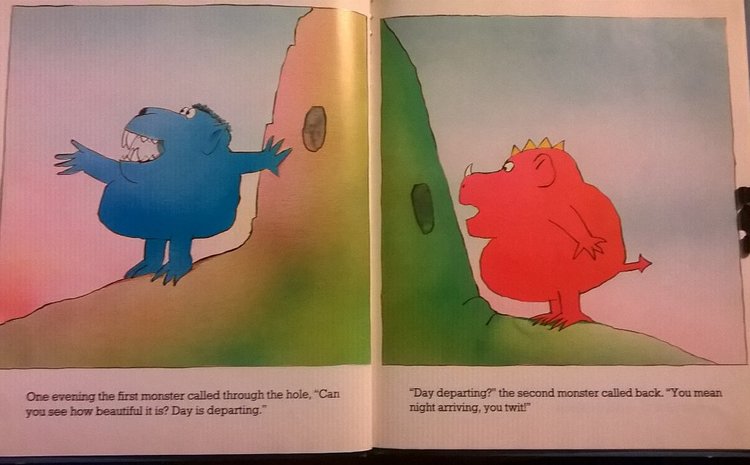
These metaphors run through my brain and quickly morph together into one of my favorite children’s stories, Two Monsters, by David McKee. This story is about, believe it or not, two monsters who live on opposite sides of a mountain. They talk to each other through a hole in the mountain and are friends until one of them comments about the beautiful sunset they can see. 

Scene from Two Monsters, by David McKee, (c) 1985.

The monsters proceed to get in a huge argument and (spoilers!) throw rocks at each other over the mountain until they wear it down, the mountain is no more, and they can see what the other was trying to describe.

We need to get rid of our mountains. We have to be able to really listen to each other, and avoid filtering what we hear through our preconceived ideas about the problem. We have to be open to being wrong and open to being right with an asterisk. We have to stop being defensive when someone has a different way of doing things. We have to stop feeling like calling on other communities to support our weak spots means we are weak. We have to work together for real — because that is how we’re strongest.

I’m really excited for our May Meeting next week where so many voices will come together to describe their piece of the elephant. We’re all going to need to get outside of our boxes and take a peek into others. But that’s starting to be too many metaphors, isn’t it?

Motion to Expand STEAM to STEAMPUNK

What started as a joke is now an earnest proposal to expand STEAM (science, technology, engineering, arts, math) to STEAMPUNK (+play, uncertainty, nature, kindness).

Video created for my Policy, Advocacy, and Leadership in Education course in August 2021.

Transcript:

STEM, or science, technology, engineering and math first appeared in the 1990s and was meant to allow the National Science Foundation to label items that involved one of any STEM fields. The acronym is now huge in the education field, with the idea that skills learned in STEM disciplines will prepare learners for future jobs and cultural understandings.

Eventually, an A for arts was added to make STEAM. The intention here was to both increase engagement with STEM and emphasize the need for creative thinking in STEM disciplines.

The two acronyms are used with such frequency that one day I jokingly thought, what if we were to add more letters and if we had STEAMPUNK? If you’re not familiar, steampunk is also a popular, retro-futuristic subgenre of science fiction.

Then the more I thought about this and gave meaning to the expanded acronym with play, uncertainty, nature and kindness, I realized that these concepts are vital to
education and what started as a joke is now an earnest proposal. To expand STEAM to STEAMPUNK.

It’s well known that play is an important part of mental, physical, emotional and social development. There’s also evidence that giving children periods of free play increases their engagement and achievement in the classroom.

We live in an era with a great many supercomplex systems and challenges. Teaching learners to be comfortable with not knowing or understanding all the details of an issue will help alleviate academic stress. Additionally, in order to find solutions to the day’s supercomplex problems, learners will need to be comfortable with the uncertainty of what the world will look like if we succeed.

There’s a wealth of research showing the benefits of time spent in nature for children and adults alike. In addition to increased feelings of well-being and improved engagement with learning, time in nature can also promote pro-environmental attitudes.

Many studies have shown a link between performing acts of kindness and feelings of well-being and happiness. Being kind to others helps our own well-being and also those to whom we are kind. Teaching learners to be kind to others and themselves can only have positive results.


Whichever acronym you like, STEM, STEAM, STEAMPUNK, an important factor for success is not to teach each concept in a vacuum. They are not independent outside of the classroom, and they shouldn’t be taught independently inside of the classroom. We need all of these disciplines to understand the world, each other and ourselves.

5 Ideas for March Mammal Madness Environmental Education Activities

One of my favorite events of the year is almost upon us: March Mammal Madness, lovingly MMM hereafter. MMM is an annual virtual competition that pits different animals against each other in scientifically plausible but hypothetical battles. The competition is designed as a bracketed game, much like the sporting event of similar name, but aims to teach participants about new species and environments through creative storytelling.

I’ve been in love with MMM since I first took note of some tweets with the hashtag on my Twitter timeline a few years ago. I’ve been an avid fan and participant every year since. I love learning about the combatants while I fill out my bracket and follow along with the stories. I love the creative storytelling of the narrators and how they tie in the scientific literature. I love the art work. I love the trash talking. I get pretty emotional about it, actually. The whole competition and the community around it encompasses everything I believe and hold dear about information, communication, and education – three things I also love. The organizers know that open research literature allows for more expansive access to scientific knowledge. They know the literature is only one way to communicate science and that other methods are needed to understand our natural world and to get humans more engaged with it. They know we need to use the vast breadth of disciplinary and traditional ways of knowing and sharing to fully appreciate this world and our relationship to it.

I’m gushing, yes, and absolutely biased and possibly misrepresenting the organizers’ beliefs. But this is what I see when I read their excellent article that just dropped and what I feel when I participant in the games.

This year, as I gear up for another exciting MMM, I can’t help but wonder how MMM can be used for environmental education, a field whose goal is also to educate and engage audiences in the natural world. Many of the MMM combatants are rare species from around the globe and sometimes from times long past. This poses a challenge for environmental ed, which tends to focus on place-based learning and getting audiences engaged with their local environments. But this challenge is also a great opportunity to stretch our definition of place-based, and to tie our local environments to the planet we all share. I’ve done some brainstorming and created a small selection of activities for environmental educators to consider to get involved with the MMM phenomenon.

Activity Ideas

Firstly, there are already a lot of amazing educator materials for MMM freely available. Many of these, especially the official materials, can be adapted for environmental education. Use your imagination or combine some of the ideas below with these:

Secondly, these ideas aren’t fully formed lesson plans or curricula. They’re merely a brainstormed list of activity ideas that you can expand on in ways that work best for your learners.

List of Ideas

  1. Find species that are endemic to your location. Offer programming about that species -their adaptions, their place in your local ecosystems, threats to their environment, etc. If the species is common enough you could go on a hike to see the animal (or evidence of the animal if more appropriate), or do a social media photo or story campaign. Of course also relentlessly cheer for them during their battles.
  2. No good species in your area? Check your nearest AZA accredited zoo or natural history museum. These organizations can offer education materials in addition to a chance for learners to see the species (or its remains, as the case may be) in an appropriate way.
  3. Consider the habits of the combatants, near and far. Have learners consider how different species would manage in your local environment. What adaptations would help them? What challenges would they face? This is an especially relevant activity given that the location of each MMM battle has big influence on the outcome. Home court advantage can give an underdog an enormous leg up.
  4. Look at some of the combatants that are endangered, at risk, or threatened. Consider what factors contribute to their status and how those factors impact your local environment and species or how your local community and lifestyle is contributing to or helping with the problem.
  5. Use the descriptions of the species to compare them to your local fauna. You can use their adaptations and physical features, diets, active hours, or other aspects to highlight similarities or differences. If you want to get more scientific, you could look at phylogenetic trees to find the closest relatives in your area to different combatants.

Resources

Official March Mammal Madness LibGuide

March Mammal Madness Educator Materials

2021 March Mammal Madness K-5 Species Info Slides

Crowdsourced Educator Resources

Hinde, Katie, Carlos Eduardo G Amorim, Alyson F Brokaw, Nicole Burt, Mary C Casillas, Albert Chen, Tara Chestnut, et al. “March Mammal Madness and the Power of Narrative in Science Outreach.” Edited by George H Perry, Penny Bishop, and Michelle Bezanson. ELife 10 (February 22, 2021): e65066. https://doi.org/10.7554/eLife.65066.

On Environmental Education

This paper was written as my final paper for my Understanding Learning course in Fall 2020. The assignment was called “Theoretical Framework” and serves as an in depth description of my educational philosophy.

The purpose of education is something I have spent a lot of time thinking about in my career and as I began this program for Natural Sciences and Environmental Education. When I read the Tbilisi Declaration (UNESCO & UNEP, 1978) in my first classes, the goals of environmental education became clear. The goals and objects set forth by the Tbilisi Declaration align well with my beliefs about the value, importance, and purpose of environmental education. The document makes explicit that environmental education must teach learners not only about the environment, but about the “economic, social, political, and ecological interdependence in urban and rural areas” (UNESCO & UNEP, 1978). This holistic goal for environment education sets the field up to address environmental justice issues and has obvious connections to ecofeminism, Indigenous education, and decolonial approaches to education. While many environmental education scholars have failed to fold these philosophies and methods into the literature and practices (Root, 2010), the Tbilisi Declaration’s goals and objectives still undergird the field; efforts to increase justice, equity, and inclusion and to decolonize are considered “mission critical” by the North American Association of Environmental Education (NAAEE, n.d.).

Another important document, Complex environmental systems: Pathway to the future (NSF AC-ERE, 2005) provides additional suggestions for environmental education. Among these suggestions are recommendations to increase participation of underrepresented communities, to use informal education to teach the public about the environment, to highlight the interdisciplinarity of environmental science, and to incorporate environmental science “into traditional courses to encourage students’ enthusiasm about science and recognition of the interconnectedness across traditional disciplines.” (Potter, 2009). 

The suggestions of this document add depth to my beliefs about environmental education, and education in general. Put in simple terms, my core belief about education is that education should encourage learners’ enthusiasm and curiosity about the world. Educators, then, should engage with their students and help them find the questions that inspire them to seek answers. Finally, education is about understanding our world, including the natural environment, our social and cultural environments, and our inner thoughts and feelings. These things don’t exist separate from each other, and can’t be understood in isolation. Education must be approached holistically – incorporating issues, methods, and philosophies from a variety of disciplines into every lesson. This includes addressing unpleasant histories and present realities, particularly as a colonized culture. Encouraging curiosity and critical thinking skills are imperative in addressing these topics and helping educators and learners alike deconstruct and disrupt modernist discourses.

Sustainability and Environmental Education

Modernist discourses include those of individualism, rationalism, consumerism, anthropocentrism, and ethnocentrism. These discourses threaten the sustainability of ecological systems and the lives that depend upon them (Martusewicz, Edmundson, & Lupinacci, 2011). Two documents that address sustainability of education with relation, however implied, to these discourses are the United Nation Sustainability Development Goal Four: Education (United Nations, n.d.) and Education for a sustainable future, benchmarks: For individual and social learning (Cloud, 2017). Within the U.N.’s goal for quality education, environmental education can connect most meaningfully with objective 4.7. This objective takes ideas about educating for environmental and sustainability awareness from the Tbilisi Declaration and the NSF AC-ERE report and expands them further to promote “a culture of peace and non-violence, global citizenship and appreciation of cultural diversity and of culture’s contribution to sustainable development.” (United Nations, n.d.). It’s important that environmental education also incorporate the objective 4.a: “Build and upgrade education facilities that are child, disability and gender sensitive and provide safe, nonviolent, inclusive and effective learning environments for all” (United Nations, n.d.) as the populations here, notably disabled and genderqueer or -nonconforming people, are not highlighted in much of the decolonization, culturally sustaining pedagogy, and environmental education literature.

Cloud (2017) describes a number of ways of thinking that contribute to sustainable education. Environmental education excels at encouraging many of these thought processes. The field allows modeling of potential futures (future thinking), looking at the world in new ways (lateral thinking), self-reflective and -directed questioning of the world and its interconnectedness (critical thinking, systems thinking, and questioning), and creates a connection to place (regenerative design thinking). 

Culturally Sustaining Pedagogy, Environmental Education, and Trust

Connection to place is one of the core facets of environmental education. It’s a goal of educators to create a connection to place, and an indicator of how engaged a person will be in environmental education. Engagement is an important goal for environmental education (McKinnon & Vos, 2015). Not only do educators want learners to engage with the lessons -what teacher doesn’t?- but they want to encourage continued engagement with the environment. 

This need for connection to place emphasizes the need for decolonized and culturally sustaining methods of teaching. If the presumed connection to place for a learner is one based in coloniality, a learner outside the dominant culture will engage neither with the lesson, the educator, nor the place. “An educator cannot sustain something in their curriculum or pedagogy, …love it, nurture it, appreciate the humanity it represents, when that thing is continually rendered impermissible, Other, to them.” (Paris & Alim, 2017). Nor can a learner love, nurture, or appreciate something -or somewhere- that is rendered Other to them.

A culturally sustaining pedagogy in environmental education seeks to find the connection that learners of all backgrounds already have to place. It asks what learners already know about a place and how the environment connects to other aspects of their lives. This type of pedagogy can build trust between learner and educator, which is shown to be a more important component to creating continued engagement than content knowledge (Baram-Tsabari & Osborne, 2015; Feinstein, 2015; McKinnon & Vos, 2015). Employing a culturally sustaining pedagogy, building trust, and creating a space of mutual learning between educator and student are overlapping approaches that environmental education needs to increase its relevance to people across communities and to create a more environmentally engaged public.

References

Baram-Tsabari, A., & Osborne, J. (2015). Bridging science education and science communication research. Journal of Research in Science Teaching, 52(2), 135–144. https://doi.org/10.1002/tea.21202 

Cloud, J. P. (2017). Education for A Sustainable Future, Benchmarks: For Individual and Social Learning. Journal for Sustainable Education, 61(4), 1–66. https://doi.org/10.7459/lt/9.1.02 

Feinstein, N. W. (2015). Education, communication, and science in the public sphere. Journal of Research in Science Teaching, 52(2), 145–163. https://doi.org/https://doi-org/10.1002/tea.21192 

Martusewicz, R., Edmundson, J., & Lupinacci, J. (2011). Ecojustice education: toward diverse, democratic, and sustainable communities. New York: Routledge.

McKinnon, M., & Vos, J. (2015). Engagement as a Threshold Concept for Science Education and Science Communication. International Journal of Science Education, Part B: Communication and Public Engagement, 5(4), 297–318. https://doi.org/10.1080/21548455.2014.986770 

NAAEE. (n.d.). 2020-2023 strategic framework: Education we need for the world we want. North American Association of Environmental Education. Retrieved from https://cdn.naaee.org/sites/default/files/naaee_strategy_framework.pdf 

NSF Advisory Committee for Environmental Research and Education (AC-ERE). (2005). Complex environmental systems: Pathway to the future [Report]. National Science Foundation. Retrieved from https://www.nsf.gov/ere/ereweb/ac-ere/acere_pathways.pdf 

Paris, D., & Alim, H. S. (2017). Culturally sustaining pedagogies: Teaching and learning for justice in a changing world. NewYork: Teachers College Press.

Potter, G. (2009). Environmental education for the 21st century: Where do we go now? Journal of Environmental Education, 41(1), 22-32. https://doi.org/10.1080/00958960903209975 

Root, E. (2010). This land is our land? this land is your land: The decolonizing journeys of white outdoor environmental educators. Canadian Journal of Environmental Education, 15, 103–119.

United Nations. (n.d.). Education. Sustainable Development Goals. Retrieved December 7, 2020, from https://www.un.org/sustainabledevelopment/education/ 

United Nations Educational, Scientific and Cultural Organization (UNESCO) & United Nations Environment Programme (UNEP). (1978). The Tbilisi declaration. Connect, 111(1), 1–8.

Community Science and Who Tells the Story about Nature

This was written as the final paper for my Environment & Society course Spring 2020

Environmental Ethic

I hold an ecocentric environmental ethic. I believe that nature has inherent value, and that all species are a part of nature. As such, I believe that access to natural spaces is the right of all animals, including humans. Not all humans have this access equally and this inequality has been discussed as an issue of environmental justice. 

Environmental Justice

Environmental justice frequently considers how pollution and the effects of climate change have more adverse consequences for marginalized people. It can also refer to how those same people tend to have less access to natural or green spaces than others have. Even when people in these groups have physical access to natural spaces, they are less likely to visit them (NPS, 2006). There are a number of theories about why this might be, one of which is that “naturalists” are often depicted as white people, usually with expensive gear and the ability to travel to “wild” places (Newsome, 2020). This depiction of naturalists raises the question Who tells the story about nature?

In addition to whiteness, nature is also frequently associated with science, which is, in turn, associated with more whiteness and with Western-style academia. This story of nature can be off-putting to broader audiences, limiting their willingness to spend time in  natural spaces. This story can cause people who don’t see themselves in it to feel disconnected from nature, and not feel that nature is a place for them. Research in environmental education holds that a sense of place is a key component for creating excitement about and concern for nature. The lack of connection to place makes it difficult to engage broader audiences with their natural world.

Sense of Place

The idea of a sense of place has been defined numerous ways in the literature (Cross, 2001; Halliwell, 2019). Themes that appear throughout the definitions include “bonding, connecting, relating, and associating through various means” (Halliwell, 2019). A person who lacks these feelings for a place may have negative associations with the place, which can happen when their environment is polluted and cared for less by larger bodies (cities, states, or country). Not seeing yourself in the place can also disconnect a person from their environment. The story needs to change to show a wider variety of people in the place.

Potential of Community Science

There are many different approaches to environmental education that take place in a variety of locations, with a variety of methods and activities. One type of activity that sometimes falls within environmental education is community science, also known as citizen science. Community science employs volunteers to collect data and partake in other steps of the research process. Community science is helpful for scientists, particularly in the natural sciences, because it allows them to collect much more data than they could on their own. Some research has also been done to examine the benefits that volunteers gain from participating in community science projects (Peter, et al, 2019). This research is encouraging, although there is very little of it. Peter et al, in their 2019 review of the literature on nature-based community science projects, found only 14 papers studying the benefits experienced by community science volunteers from through 2017. Almost all of these papers found that participants in community science projects experienced positive benefits from their work, including gains in knowledge about their environment or study species, positive attitudes changes towards nature or their study species, and an increased sense of place.

Haywood (2014, 2019) and Haywood et al (2016) have looked most frequently and elaborately into the effect that participation in community science can have on volunteers’ sense of place. He has found increases in connection to place in volunteers’ work on a project monitoring coastal birds. He hypothesizes that the repeated visits to the locations where monitoring took place helped build this sense of place that volunteers reported. Halliwell (2019) found similar results for volunteers in community science programs in two National Parks. These results show real potential for community science to help build a sense of place for participants. Some research shows that building a sense of place is usually only done over long periods of time (Raymond et al, 2017) and community science may be a way to get this result more quickly.

Limitations of Community Science

While community science looks to be an exciting way to allow people to write themselves into the story of nature, there are still barriers that leave behind the same groups of people. Demographic information is not often collected about who participates in community science, but it’s easy to imagine that participants have the privilege of time to volunteer, and likely already identify as interested in nature and science to some degree. Commonly referred to as “citizen science,” the activities can also be off-putting to non-citizens, and even “community science” can fail to attract people who don’t feel they are part of “the community.” Many people in this country believe they aren’t adept at science and may be disinterested in any science activities. The literature does little to address or even identify these problems of participation in community science.

One area that is thinking more diversely about who community science helps is environmental justice. Community science is a useful method to expose inequalities in the environment, such as air and water quality and access to green space. Dhillon (2017) acknowledges that lay scientists (volunteers) and professional scientists may fall into opposition with each other during community science projects. She notes that community science brings together these different knowledge bases and calls for these knowledge bases to instead interrogate each other to strengthen the knowledge they create. Community science projects with goals related to environmental justice issues are more likely to include groups that are generally not represented in the story of nature. These projects give participants a sense of ownership over their environments (Dhillon, 2017; Jiao et al, 2016; Rickenbacker et al, 2016), which contributes to a sense of place. 

Recommendations

It’s difficult to determine the best recommendations to increase diversity in community science participation, or to increase the cultivation of a sense of place. The literature about outcomes for community science volunteers is sparse and there is no standard framework for evaluating outcomes. Peter et al (2019) make the recommendation that nature-based community science projects should be designed along with social scientists to make use of established educational frameworks to evaluate outcomes related to knowledge gains and other measures of success for participants. Peter et al also recommend that research be done on multiple community science projects, rather than single case studies that are quite common, and more longitudinal studies about the long-term effects of participation on volunteers. These recommendations would all improve our understanding of how volunteers benefit from community science and what factors produce which benefits. Haywood (2014) also recommends more research to see what factors lead to an increased sense of place.

The community science projects with the most benefits for volunteers are those that are co-created by the community and scientists. In addition to working with social scientists, natural scientists creating community science projects should have volunteers from the community help establish research questions and methods. These tactics help increase trust in science and feelings of accomplishment by volunteers (Peter et al, 2019). This process could also increase the volunteers’ sense of place by encouraging them to think about their place in the community and how they relate to it.

Conclusion

Nature-based community science projects have potential to rewrite the story of nature to include more people, but the project must make concerted efforts to get members of underrepresented groups to participate and engage with the project. Professional scientists must connect to the community they’re studying and working with and respect the knowledge people there have about their community and environment. If a scientist pushes their own narrative about the environment onto the community, they will squash any hope of rewriting the story of nature. 

References

Cross, J.E. (2001). What is sense of place? 12th Headwaters Conference, Western State College, November 2-4, 2001.

Dhillon, C. M. (2017). Using citizen science in environmental justice: Participation and decision-making in a southern california waste facility siting conflict. Local Environment, 22(12), 1479-1496. doi:10.1080/13549839.2017.1360263

Halliwell, P.H. (2019). National Park citizen science participation:Exploring place attachment and stewardship. (Publication number 134613880267). [Doctoral dissertation, Prescott College]. ProQuest Dissertations and Theses Global.

Haywood, B. (2019). Citizen science as a catalyst for place meaning and attachment. Environment, Space, Place, 11(1), 126-151. doi:10.5749/envispacplac.11.1.0126

Haywood, B.K. (2014). A “sense of place” in public participation in scientific research. Science Education, 98(1), 64-83. doi:10.1002/sce.21087

Haywood, B. K., Parrish, J. K., & Dolliver, J. (2016). Place-based and data-rich citizen science as a precursor for conservation action. Conservation Biology, 30(3), 476-486. doi:10.1111/cobi.12702

Jiao, Y., Bower, J. K., Im, W., Basta, N., Obrycki, J., Al-Hamdan, M. Z., Wilder, A., Bollinger, C.E., Zhang, T., Hatten, L.S., Hatten, J., &  Hood, D. B. (2015;2016;). Application of citizen science risk communication tools in a vulnerable urban community. International Journal of Environmental Research and Public Health, 13(1), ijerph13010011. doi:10.3390/ijerph13010011

Newsome, C. (@hood_naturalist). (2020, May 29). MAJOR ANNOUNCEMENT!!!!!  We at @BlackAFinSTEM are starting the inagural #BlackBirdersWeek to celebrate Black Birders and nature explorers, beginning 5/31!!!!! Follow the whole group of us here: https://twitter.com/i/lists/1266155155743027202 Take a look at the thread for the schedule of events! [Tweet]. https://twitter.com/hood_naturalist/status/1266387163727486977

Peter, M., Diekötter, T., & Kremer, K. (2019). Participant outcomes of biodiversity citizen science projects: A systematic literature review. Sustainability,11(2780). doi:10.3390/su11102780

Raymond, C. M., Kyttä, M., & Stedman, R. (2017). Sense of place, fast and slow: The potential contributions of affordance theory to sense of place. Frontiers in Psychology, 8, 1674. doi:10.3389/fpsyg.2017.01674

Rickenbacker, H., Brown, F., & Bilec, M. (2019). Creating environmental consciousness in underserved communities: Implementation and outcomes of community-based environmental justice and air pollution research. Sustainable Cities and Society, 47, 101473. doi:10.1016/j.scs.2019.101473

U.S. Department of the Interior/Office of Congressional and Legislative Affairs. (2006). NPS Visitation Trends. https://www.doi.gov/ocl/nps-visitation-trends
Scholarly Communication, Research Communication, and Digital Scholarship

I started my career in librarianship because I saw great value in sharing information. It was no surprise then when I got involved with scholarly communication, digital scholarship, and research communication. The three fields are distinct, but have considerable overlap. I spend a lot of time trying to differentiate these fields in my mind and for my colleagues. This post is meant to help me express these lines of thinking.

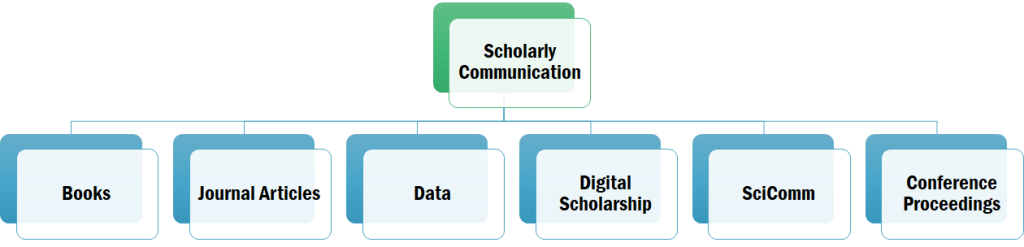
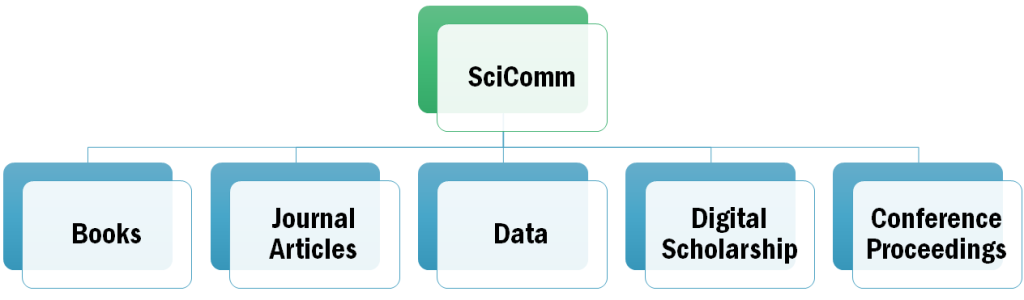
Scholarly communication, for those unfamiliar, is generally considered to be the outputs of research that tell others about that research. This traditionally includes books, book chapters, journal articles, and conference proceedings.

Theses aren’t however, the only outputs of research. Researchers frequently create datasets that inform their written works. Digital scholarship –maps, interactive websites, games, virtual reality and anything else you can imagine – has grown into a common expression of research results. Blog posts, Twitter threads, newspaper and magazine articles, and podcasts have also been ways for researchers to express their research findings for a long time. These and other less formal communications are often put into the category of science communication, or, as I’ll be referring to it, research communication.

Since all of these things are research outputs meant to communicate research findings, they could all be put under the scholarly communication umbrella.

Chart with Scholarly Communication linking down to Books, Journal Articles, Data, Digital Scholarship, SciComm, Conference Proceedings
Made with Microsoft’s SmartArt. Thanks, Microsoft.

And since research communication has similar goals, perhaps books, journal articles, conference proceedings, data, and digital scholarship could also be grouped under this umbrella.

Chart with SciComm linking down to Books, Journal articles, Data, Digital Scholarship, Conference proceedings
Made with Microsoft’s SmartArt

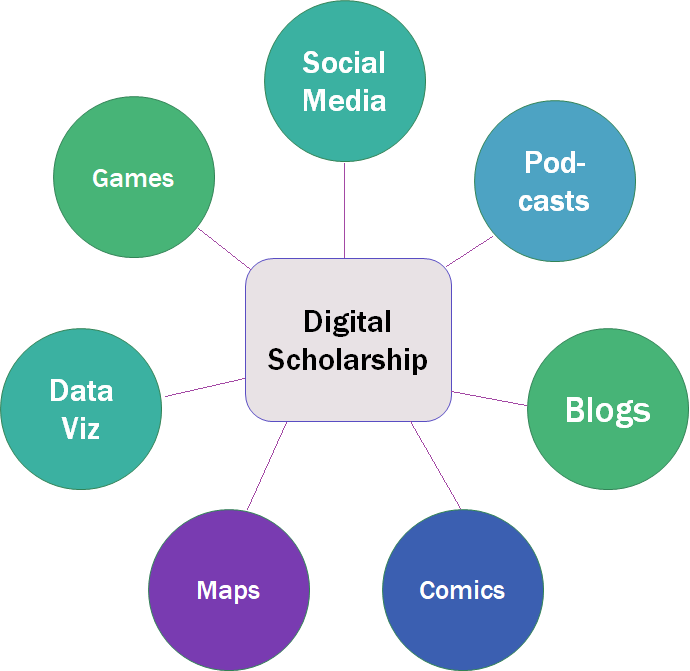
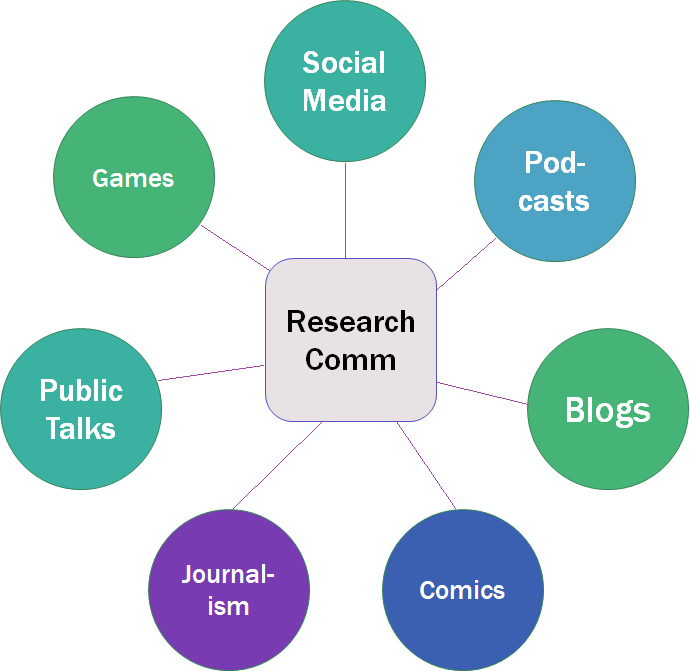
More similarities can also be found between research communication and digital scholarship. It’s well accepted that research communication includes social media, podcasts, blogs, comics, games, journalism, public talks, and more. Digital scholarship also includes social media, podcasts, blogs, comics, games, and other things that could be research communication like maps and data visualizations. Two things that fall under research communication that don’t fall under digital scholarship -probably- are public talks and journalism. And even then there are probably examples where that’s not true.

Wheel with Digital Scholarship at the center linking out to Social media, podcasts, blogs, comics, maps, data viz, games
Made with Microsoft SmartArt
Wheel with Research Comm at the center linking out to Social media, podcasts, blogs, comics, journalism, public talks, games
Made with Microsoft SmartArt

But despite the interchangeability of the umbrella-ness of these fields, they aren’t interchangeable concepts. That have a variety of differences, but one of the big ones is the audience of each.

Scholarly communication is largely directed at other researchers and academics. Research communication is directed at the general public. Digital scholarship may be meant to reach either audience, but leans towards other academics. Digital scholarship differs from scholarly communication and research communication in how it approaches the work.

Digital scholarship is concerned with the methods and tools of creating these projects. It takes into account findability and how the projects can be accessed, preserved, and reproduced over time. Digital scholarship is probably the most involved in critically evaluating the ethics involved in the work of creating projects, followed by research communication. Scholarly communication, being the most entrenched in The Way We’ve Always Done Things in academia tends to consider ethics with the lightest touch (which is not at all to say people working in this field aren’t thinking about ethics – there are great folks in the field who are indeed considering these aspects).

Scholarly communication, digital scholarship, and research communication are perhaps less competing umbrellas and more different parts of a mobile. Or a Rubic’s Cube. Or a relational database. In any case, they all serve important functions in communicating research to people and I therefore love them all. More importantly, though, the deep relationships between these three fields means they can learn from and teach one another. Education is another heart in this collage, but that is a post for another day.

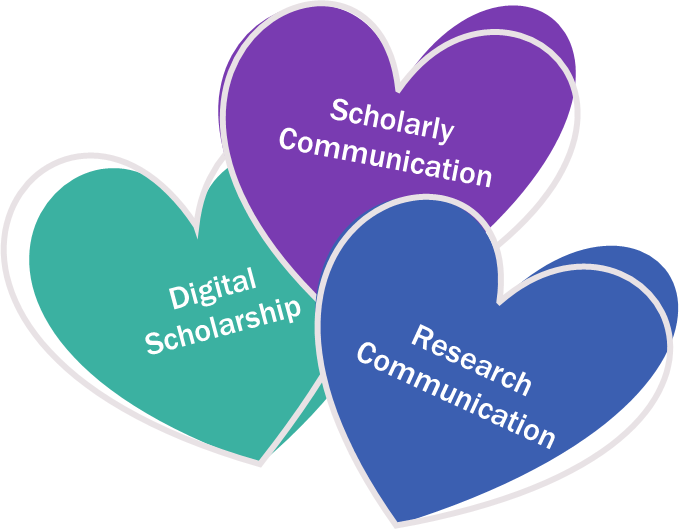
Three hearts overlapping. One says scholarly communication, one says Research communication, and one says digital scholarship
Awww

So Your Library Is Closing

This post was originally published on my Missed Points blog on April 15, 2016

We’ve known for a while that the branch library where I work (a STEM library at a university) would close eventually. Some years this has meant very stressful uncertainty about whether or not we’d be here at the end of the year. The Maybes were really hard – probably harder than getting the real date we have to close. We’ll be out in about 9 months 2 months so the academic building we’re in can create more lab space, which is a totally legitimate reason to kick us out. Nevertheless, our small staff that works here is pretty bummed about this and it got me thinking about all the other stories I’ve heard or read about library branches or just libraries full stop that have closed. These stories always discuss the loss of service to the populations those libraries served and often include quotes from users who are upset about the loss. I’ve noticed, though, that few stories -unless told by the librarians themselves- talk about what the librarians think about the closure, or how they are feeling their feels. I am feeling a lot of feels right now and I think maybe we (librarians) all need a support group for this kind of thing. Failing that, I wanted to capture some documented emotions from others and some information about how to deal with reorganization/layoffs. So…

 Stories of Other Grieving Librarians

It was really hard to find stories about libraries closing that talked to the librarians and also mentioned how the librarians felt. Please share if you know of others. These represent some different types of libraries and although they have differences from my experience and library, we all have the same emotional process about it, it seems. Note to journalists: If your covering library closures, you’re bad at your job if you don’t at least try to interview the librarians.

  • Branch closings hurt, library director says (2001):
    “It makes me so emotional. I am a career librarian. It hurts. People say they’ve cried over this. I’ve cried, too.”
  • County to Shut 10 Libraries, Cut Hours at All Branches (1992)
    “It’s going to be terrible…People from the community, you get to know them. They become your friends.”
  • Niland library closing is ‘sad situation’ (2010)
    “I really love this little place.”
  • Stanislaus County Library Lays Off 94 Part-Timers (2008)
    “I hope the public understands that we are trying to do the best we can.”
    “I feel sad for the community”
  • Searching the MedLib-L listserv archive for subject line “library closing” gives a warning that “Your search produced too many hits and the query was aborted.” This is very sad in and of itself, but reading those emails is sadder still. Many of these messages show the pain these librarians felt at the closure of their and their colleagues’ libraries. Many of these talented people were laid off in the process. Just a major, major bummer.

Other Articles about the Emotional Effects

There are a lot of articles about the emotional effects of reorganization and layoffs. These also tend not to give perspective from actual people going through the effects, but they offer some interesting advice and insights to why we get sad about it all. Layoff articles about those laid off were harder to find than articles about “survivors” of lay offs and support for management during layoffs.These articles got kind of depressing so I left the list pretty short. There’s a lot out there, though. You’re probably a librarian, so you know how to find more.

Reorganization

Layoffs

All My Feels

I am sad. One of the reasons I took this job was that it was in a branch library. I can’t tell you how much I believe in the value of branch libraries. They’re really quite something, and Barbara & Michael do a good job summarizing why here (hoping not paywalled!). I’m not sad that I’ll be in the main library now. I’m lucky to still have a job – not all librarians who lose their libraries are so lucky. While having a much deserved drink with some understanding work friends recently, one noted how losing our library was also losing our professional identities. I agree. I haven’t been here that long (it will be almost 3 years when we leave), but this is my job. I work here. The differences between Us and the Main Library have been clear for as long as this branch has operated, no matter how much we try to be united. Being a separate entity has often had many problems for us with regard to our budget and our professional relationships. But what happens to the Red Headed Step Child when they get invited to stay in the main house with the other kids? It’s going to be an adjustment. Our shack out back had it’s problems, but it was home. And yes, we’re going to insist on continuing to support our users in the main library. That’s going to be an adjustment for them and we’ll have to deal with some (totally ridiculous) push back. I hoping the staff over there will check their “Why do we need to change things to serve STEM kids?” and “About time you came over here” comments and be a bit more sympathetic. I fear any good things that could happen by incorporating us into the Main Library will be made very difficult without sympathy from the librarians there. [Note: Since first drafting this, we’ve received many kind words from Main Library staff. I’m very appreciative of this and hope it continues.]

Another thing that makes this sad is certainly the loss of community. The students who used our library are going to lose this community and that is sad. But we -the staff at this library- have been part of the community as well. We’re also losing that community. We’re losing being able to see our students and our faculty everyday. We have to adjust to a new community in the main library. We’ll have to work harder to see faculty because they won’t work harder to see us. We likely won’t have the same kinds of relationships with the main library student workers. Sadness.

We also have a lot of work to do. We have to map all our things to new locations. We have to map all our services to new units. We have to figure out what our jobs are going to be in the main library. We have to empty our offices (dear, God!) and move all our crap to some random corners of the main library (and listen to people complain about having to empty those random corners for us). We have to figure out what to do with all these business cards. We each have a running list of Things To Do with us at all times. And we still have to do our regular work. We have to meet with students. We have to teach. We have to keep buying books our users don’t need. We have to keep developing and growing as professionals. And we have to do all these things while being really sad (and, let’s be real, sometimes angry) about losing our home.

A question that has come to my mind during this, and came up a lot more during the Maybe days, is Did we fail? During those Maybe days, it felt like perhaps we could’ve stayed more relevant and had a greater perceived value if we’d had the financial support to do the things we wanted to do (quick reminder that these opinions are mine and do not necessarily reflect the views of my employer). Today, though, I don’t think we failed. Everyone’s hands were tied here and many higher ups in the academic college whose space we’re occupying have come to us to express their dismay at having to make the decision to close us down. Those comments are so important and we are immensely grateful for them. I know of other libraries where that is not the case. Reflecting on this question is in itself a painful process, though, especially when the blame can’t be so easily placed. I feel like a lot of library closures could be avoided if the case being made for the library was better made to the public and The Powers That Be. I think Libraryland at large is terrible at explaining our value, especially when we’re serving populations that don’t do historical research or use Books. This is where Main Libraries could do better (and where LIS education could do better). It’s been my experience that most Main Libraries (and LIS education) are particularly bad at advocating for those groups. I can feel myself going into my tangent about this, and that will take away from the point of this post so I’m stopping there. One thing we hope The Powers That Be take away from our closure is how important spaces like ours are to students. I think we’ve done a really good job of making that clear and hopefully all the new buildings going up around here will take that into consideration. They won’t, but hopefully at least one person will raise the issue at meetings about them.

One of my colleagues at my library threw out an idea that I love and we’re thus far planning to do: a Grand Closing event. I think this will be an amazing way to provide students and other users with information about where the services they’ve grown used to will be once we close and allow us all to grieve our loss and pay tribute to this place we’ve been so fortunate to have. We were going to have a Grand Closing Party but then they decided to kick us out at the end of June instead of December and no students will be here for such a party. We might do a Library Staff and Whatever Faculty Are Around Good-Bye Party. I would love to have a black tie gala -with booze and a big band jazz troop- but I won’t hold my breath for that. Maybe I’ll dress up and drink in my office alone the night before.

I was going to document some of the closing activities we’ll be doing and share that documentation to personally pay some tribute to this place and give us a proper send off. But now we’re on a crazy short time table and we can’t do any of the things we wanted to do. If your library is closing (so sorry!) and you want some ideas for things to do for patrons, I’m happy to share what we were going to do.

Support Group

Please use the comments section -at least in part- to share your own experiences with closures and your emotions. That’s the best I can do for a support group at this point. I imagine most librarians going through this go through some serious emotions. When my feels started bubbling up, I really wanted to hear other librarians’ stories and found that was a difficult thing to find. I hope this post can retroactively help those who have already lost their libraries and in-time help those who go through this in the future.

Let’s Talk about SciHub

This post was originally posted on my Missed Points blog on March 4, 2016

I so badly don’t want to go into the background of what Sci-Hub is. If you want to read more about what this is and why a lot of people’s feathers are ruffled about it, you have many options. Here’s the tl;dw (the w is for write) version: Sci-Hub is a repository of stolen research articles that allows users to get access to the usually pay-walled articles (translation: articles that need to be paid for to be read) for free.

That sounds good, right? In fact, I think (on the surface) it sounds pretty awesome. I’ve long said (and stood by it enough to make it my Twitter description bit): “Information (the good stuff) could save the world if only those who need it could find & access it.” I’m strongly in favor of increased free access to information and pretty cranky at how inexplicably expensive most information is. Plenty of people writing about Sci-Hub are cranky about that and other things, but there are some points that everyone seems to be glossing over, missing, or not mentioning at all that I really want to get out and into the conversation. Let’s discuss the players and the things being said about them.

Publishers. The Big 5 publishers, to be exact. They charge an arm and a leg for articles, journals, and cleverly designed journal packages. This is not good. Libraries aren’t particularly well funded but are the ones who must pay for this stuff. When libraries can’t afford it, they often offer inter-library loan but all the same get grumbles from researchers and students that things aren’t immediately available. When publishers try to play the open access game, they charge often totally absurd fees to authors, and sometimes the library pays those, too. This is all ludicrous because the research that libraries are paying for their institution to read about was done by people at other institutions, many of them public. The institutions paid the salaries of the researchers, whose job it is to do research and, explicitly or not, to write about what they found. The research may additionally have been paid with public funds from, say, the NSF or NIH. So the publishers didn’t have one thing to do with creating the research or paying for researchers to do it, but they’re profiting from it. By wide margins. Really, really wide margins. I have no complaints about how Sci-Hub commenters have been painting the publishers. The Big 5, at least. Crankiness is deserved.

Sci-Hub. So Sci-Hub is making some folks cranky and others cheer for joy. The joy is due to the sticking-it-to-the-man-iness of it and, you know, the making stuff free. That’s fine. Those are things to be joyful about. For the huge number of researchers who otherwise don’t have access it’s an invaluable service. The crankiness is for a few things. Firstly, what Sci-Hub is doing is definitely illegal. Not only are the articles generally owned by the publishers, but they are stealing log-in credentials from people at universities to get the articles through the libraries’ subscriptions. It’s that latter thing that makes me cranky, and not just because of the security risks involved. And this is the point that I don’t think others have really driven home that upsets me most: Sci-Hub still relies on the broken publishing system we have. Sci-Hub requires that publishers keep publishing stuff and libraries keep paying for it. This is not a solution. It also has the potential to exacerbate the problem as publishers could certainly raise their prices claiming the need to recoup the costs lost to Sci-Hub.

Another major problem that isn’t being talked about as much as it should be is how Sci-Hub joins libraries paying the bill and access to ILL in obscuring the extent of our broken system from the privileged researchers who, ultimately, are the ones who could fix it. If they have access to everything they need, and everyone else has access, too, then they don’t need to change their behavior, right? Spoiler alert: They do need to change their behavior.

Last but not least, Sci-Hub’s founder and runner, Alexandra Elbakyan is upsetting me by tweeting and commenting on things about how she’s making these works open access. Sci-Hub is not making anything open access. Things that are open access are not stolen and not under the copyright that these works are under. You don’t have to steal open access works because they were born free. Don’t believe this nonsense that having your work in Sci-Hub means you’ve met public access or open access policies set by your funder or your institution. There are legitimate ways to make your work open access like publishing in open access journals, paying author fees to make your work open access in a closed access journal, or self archiving in reputable IRs.

Libraries. There’s some crankiness at libraries for a few reasons. I’m biased, because I am a librarian, but I think a lot of this is over-blown or unfair. First, libraries pay the Big 5 publishers for their content. This is largely true, but, really, we don’t have a choice. As stated previously, researchers and students want and need access to these articles and grumble when they don’t have it. We can’t just not subscribe, even if Sci-Hub exists (because Sci-Hub needs our subscriptions to get its own content, remember). We could probably have been doing a better job at not getting as entangled with publishers in the first place, but we can’t really fix the past yet, can we? Next claim for crankiness: libraries haven’t done enough to get the Open Access thing going. We’ve been yelling about this for years. Since 1994 at least. We have events. We have workshops. We have scholarly communications librarians sending emails to people everyday asking them to publish open access. The truth is no one listens to librarians (that’s why everyone thinks we’re so quiet). We’ll talk more about this point in a second. Finally, libraries are taking flack for being either too for or against Sci-Hub. We teach people about copyright, so we’re pretty well aware that, from a legal standpoint, Sci-Hub is doing something wrong. But we also like information to be available to as many people as possible. So, yeah. I’d say most of us are a little conflicted. I’m not that conflicted. And that’s due to our final, least often discussed player here.

Researchers: Meet me at at camera 3.

I love ya. But you’re the reason the publishing system is broken.

You’re the ones who could and should be insisting that you keep your author rights (remember when I said the publisher probably owns the article?) so you could archive a copy of your work in a reputable, open repository -both things a librarian has probably offered to help you with at some point.

You’re the ones who should be publishing in open access journals to begin with whenever you can afford it. A librarian could easily point you to good ones that aren’t scams. There are lots that aren’t scams. You library might even have a fund to pay those fees for making it open for you.

You’re the ones who, at the very least, could be critical thinkers when looking for places to publish. A journal with a high impact factor might seem like the best choice, but if that journal publisher has questionable business practices (like not giving free or discounted access to lower income institutions or developing countries or having 30+% profit margins) or if your library can’t afford to pay for it – find a different publisher! You could totally ask an acquisitions, electronic resources, or scholarly communications librarian about it if you aren’t sure. Librarians know stuff and are generally nice.

You should be talking about this with people in your discipline, trying to find new ways to publish stuff. Look at physics and arxiv.org. You’re not totally off the hook, physicists, but good job with arxiv. Don’t stop using it.

And, to those of you on promotion and tenure committees, why are you using impact factors and h-indexes for rating researchers anyway? These are deeply flawed metrics and a librarian has probably told you that, too. Shouldn’t we be rewarding people for doing research well and making their work available to help other people make more discoveries? Isn’t that the point of science? When did it become a secret club that only people at wealthy universities in wealthy countries could partake in? Doesn’t this all seem crazy to you? I bet a librarian or two has been trying to tell you this makes no sense for a long time. Maybe it’s time to listen to them.

The System Is Down: Could it be space weather?

This post was originally published on the SEL Blog for Temple University on March 7, 2014

If you’ve tried to do research using the libraries’ services this week, you may have encountered a few hiccups. The computer labs in the Paley Library lost their network connection for a little while and our EZBorrow system and Summon discovery service weren’t working properly. All these problems have been resolved and we’re all very sorry of the inconvenience these issue caused. It seems odd, though, that they all happened in the span of a week.

I did a little research and found a possible scapegoat for all of the libraries technical problems: space weather. On February 24, NASA’s Solar Dynamics Observatory witnessed a massive solar flare. It had a class of X4.9.

news report on AccuWeather.com explains how solar flares are measured thusly:

“Solar flares are measured on a scale of intensity ranging from A, B, M, C to X. The X-strength flares, the level the recent solar activity has been categorized as, are the highest strength.”

The number after the letter also relates to strength. X2 is twice as strong as X, X3 is three times as strong. So the flare on the 24th was 4.9 times stronger than an X-class flare. That’s pretty strong!

Time lapse photo of the recent solar flare

Solar flares are impressive to watch, but they also can cause a chain reaction that results in problems for our communications infrastructures here on Earth. The solar storms affect our ionosphere and magnetosphere which in turn leads to “electromagnetic induction in long electrical wires” and “electromagnetic interference leading to communications disruption.” (Howard, 2014). Our network issues this week could certainly be described as communication disruptions.

Solar activity has caused trouble in the past for communications. In 1998, a solar flare knocked out the functionality of 80% of pagers (Eagleman, 2012), which sound ridiculous but it was real problem for physicians and other professionals at the time. In 1989 Quebec’s power grid went down completely after a huge solar storm erupted. Several other cities in the Northeast had damage to their power grids and radio communications in Russia were failing as well. The largest solar storm recorded was in 1859 and is called the Carrington Super Flare. The Carrington flare didn’t affect any pagers for obvious reasons, but it lit up the night sky across the globe.

So, is the solar flare of February 24 the cause of network problems at Temple University Libraries this week? Maybe. Solar activity could cause these types of problems and, given that it takes a few days for the outbursts to impact us, the timeline makes sense. But I’ll let you come to your own conclusions.

Read more:

Suggested search terms: “solar flares”; “solar storms”; “space weather”; “coronal mass ejections”; Carrington Super Flare; geomagnetic storms

If we must talk about the weather, at least let us talk about space weather.

Science of Therapy Dogs

This post was originally published on the SEL Blog for Temple University on December 9, 2013.

Bernese Mountain Dog

If you’ve been at Paley Library this week, you may have noticed we have some visiting therapy dogs. The dogs are with Therapy Dogs International and are here to help you relax before and after your final exams.

If you like dogs, you already think this is a great idea, right? But spending time with dogs or other therapy animals has been shown in numerous studies to have physical and mental health benefits for participating humans. A review article by David Marcus summarizes the findings of some of these studies:

The study by Odendall and Meintjes also tested the stress levels of the dogs providing therapy for humans. They showed that the therapy dogs benefit from increases in hormones like endorphin, oxytocin, and dopamine. However, while the experience is a positive social experience for the dogs, it is not a stress reliever for them – it’s a job. While it’s not the most taxing of professions, “sitting or standing quietly, maintaining a high level of obedience and calm instead of engaging in play, and accepting handling from strangers require work and effort by the therapy dog.” (Marcus 2013.) The dogs need breaks now and then while on the job, but they’re happy to have you spend time with them.

You can read more about these studies in the links above or in the following review articles. If you missed the dogs today, you can still relax with others tomorrow and Wednesday!

Further reading:

Photo credit: “Playful Mood” by Takashi Hososhima via Flickr  http://www.flickr.com/photos/htakashi/10635512194/